
A district-scale copper-gold porphyry project located in the heart of Northern Chile's world-class Collahuasi mining district
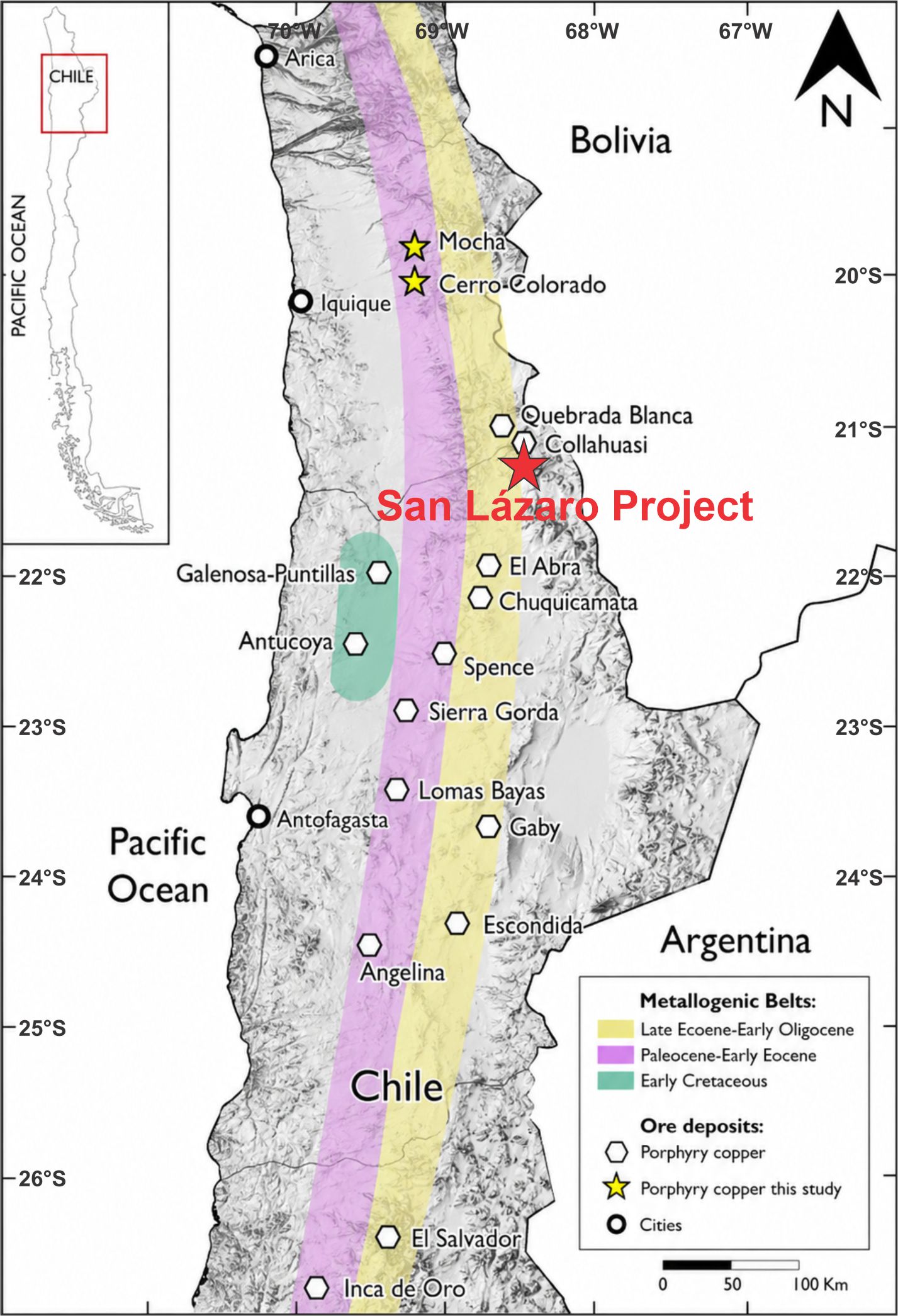
The San Lázaro Project is a 1,600-hectare copper-gold porphyry exploration project located just 15 km south of the Collahuasi mining district in Northern Chile, featuring a large undrilled geophysical target in one of the world’s most productive copper belts with strong potential for a significant discovery.
Summary
San Lázaro lies within the highly prospective Upper Eocene-Oligocene porphyry copper belt and benefits from excellent infrastructure, year-round access, and close proximity to major mining operations. Historical work by Rio Tinto, CODELCO, and ASARCO identified extensive chargeability anomalies and intersected broad intervals of copper-gold mineralization beneath shallow gravel cover.
A recent geological reassessment has refined these results into a compelling, largely untested target measuring approximately 2 km by 1 km, where integrated geological, alteration, and geophysical vectors strongly indicate the presence of a concealed Tertiary copper-gold porphyry system — representing the next key phase of exploration for the project.
Project Overview
Strategic Development
1,600 Hectares Under Concession
4,725m of Historical Diamond Drilling
Key Highlights
Located 15 km south of the Collahuasi mining district, one of the world’s premier copper-producing regions.
Ten diamond drill holes totaling 4,725 m completed in 2015.
Large 2 km x 1 km undrilled porphyry target identified through geological reinterpretation.
Strong chargeability anomaly consistent with major porphyry copper systems in the district.
Geology
San Lázaro is located within the Upper Eocene-Oligocene porphyry copper belt of Northern Chile, a highly productive geological setting that hosts some of the largest copper deposits in the Central Andes. The project lies in the broader Collahuasi district, where multiple generations of porphyry mineralization have been identified. Notably, there is a well-documented spatial relationship between older Paleozoic porphyry systems and younger Tertiary porphyry deposits. This recurring mineralization pattern, confirmed by age dating at mines such as Quebrada Blanca, Rosario, and Ujina, is particularly evident in the Collahuasi district, where Upper Eocene-Oligocene copper porphyries (36.2–32.6 Ma) were emplaced in the same structural zones as earlier Middle Permian systems.
Exploration Target
Geological modelling indicates that the broad intervals of copper-gold mineralization intersected in previous drilling represent the peripheral expression of a larger, concealed Tertiary porphyry copper-gold system. Supporting this interpretation are consistent alteration patterns, sulphide distribution, and strong chargeability anomalies.
Reinterpretation of historical data has defined a compelling 2 km by 1 km undrilled target located east of drill holes 4, 6, and 9. This zone lies beneath 70–100 metres of gravel and Miocene volcanic cover and sits within a moderate to strong chargeability anomaly (>25 mrad). The target is sufficiently large to host a significant porphyry deposit similar to those currently mined in the Collahuasi district and can be efficiently tested with 4 to 5 vertical diamond drill holes to depths of 500–800 metres.

San Lazaro reassessment and target identification
Reinterpretation of the historical exploration results suggests the possibility to explore a Tertiary porphyry Cu deposit near or adjacent to the previous blind low-grade mineralization discovered by drilling in 2015. Alteration and mineralization vectors indicate a 2x1km undrilled area located to the east of holes 4, 6 and 9 as the most prospective zone to evaluate a mineralized Tertiary porphyry Cu deposit under 70-100m of gravels and Miocene volcanic rocks. This area is also broadly included in a moderate to strong chargeability anomaly (> 25 Mrdans) as it is showed in the next figure.

This target is sufficiently large to host a significant mineralized porphyry Cu deposit like those currently being exploited in the Collahuasi district. The target can be easily drill tested with 4 – 5 vertical diamond holes with depths varying between 500 to 800m.
The next figure is a schematic cross-section showing the previous drilling results and the proposed drill porphyry Cu-Au target.